Home » Concrete Batch Plant For Sale » Ready Mix Concrete Plant
ready mix Concrete Plant
Capacity: 25m ³/h ~ 240m ³/h | Type: stationary, mobile & compact | Cost: $18,000-$350,000
A ready mix concrete plant is more than just a mixing facility; it is a specialized production hub engineered for consistent quality and rapid commercial supply. By centralizing the manufacturing process, this type of plant allows contractors and ready-mix producers to deliver high-specification concrete to diverse job sites with surgical precision. The defining advantage is the ability to manage complex mix designs at scale, ensuring every batch meets the exact requirements of the project.
As a leading manufacturer with over 30 years of industrial expertise, we have perfected the production logic required for high-volume urban and infrastructure projects. Our systems are developed to balance high-speed throughput with unyielding consistency. With a modular design that adapts to diverse site conditions, our equipment provides the reliable foundation needed for the world’s most demanding engineering feats.
hot-sale models of ready mix concrete plant
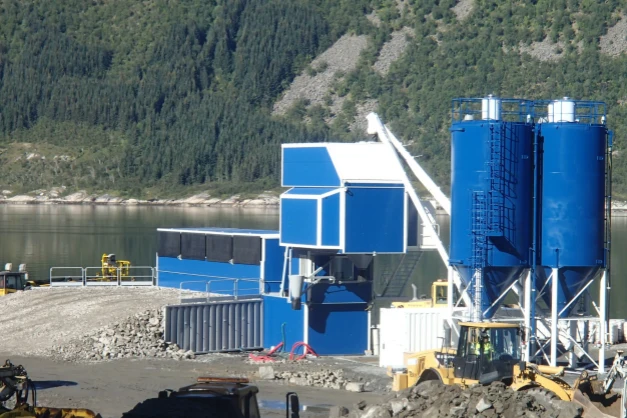
Ready Mix Concrete Plant Price List
When budgeting for a new venture, the first question investors ask is regarding the base ready mix concrete plant price. It is important to note that the cost of the machinery varies significantly based on theoretical capacity, the number of storage silos, and the sophistication of the automated control systems. The exact price depends on its configuration, machinery, size, selected model, and customer specifications. The optional configurations offered by us include, but are not limited to: number of cement silos, size of the batching machine, belt conveyor, hopper conveyor, dust removal system.
Below is a general reference guide for FOB (Free On Board) equipment prices in the current global market.
| Best Products | Capacity Range | Price | The Profile |
|---|---|---|---|
| Small RMC Plant | 25 m³/h to 50 m³/h | $30,000 – $60,000 | Often utilizing a space-saving skip-hoist design, these compact units are the perfect entry point for start-ups, rural infrastructure suppliers, or temporary project sites. The small RMC plant price offers the fastest route to generating positive cash flow with minimal upfront risk. |
| Mid-Size Commercial RMC Plant | 60 m³/h to 120 m³/h | $65,000 – $130,000 | This is the industry “sweet spot” for standard commercial operations. A robust RMC plant price in this tier includes a continuous belt-conveyor feeding system, a 1m³ or 2m³ heavy-duty central mixer, and a fully automated PLC cabin capable of managing multiple truck fleets simultaneously. |
| Mega-Capacity Industrial RMC Plant | 150 m³/h to 240 m³/h (or dual-mixer setups) | $150,000 – $300,000+ | Engineered to dominate local markets or supply national-scale mega-projects. This investment tier covers advanced features such as pulse-jet dust collectors, fully enclosed environmental cladding, and specialized additive dosing systems. |
The price is for reference only. Please get in touch with us for the latest quotation.
Important Note: The figures above represent the base machinery price tag. The total capital required to start a commercial ready-mix business is higher. Keep reading to get a complete view of the financials.
ready mix Concrete plant manufacture
A ready-mix plant is more common and widely used in concrete mixing plants. The remarkable feature of the rmc concrete batching plant is that the production of concrete is not directly on the site, but needs the transport truck to transport concrete to the construction site, which is also the reason why it is called the ready mix batching plant. We provide equipment and models such as mobile concrete batching plants, stationary concrete batch plants, and compact concrete batching plants. We can also design personalized or customized solutions according to the needs of customers.
(1) Stationary Ready Mix Concrete Plant
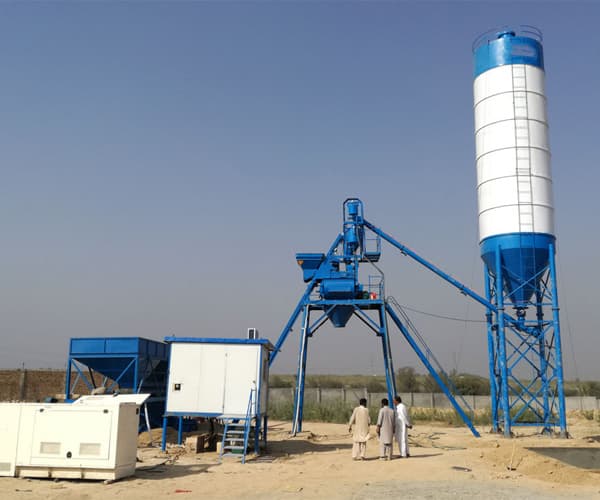
Skip Hopper Type
| HZS25 – HZS75 | Designed for compact sites and cost-effective operations. The bucket lifting system occupies less ground area and requires simpler maintenance. Ideal for capacities from 25m³/h to 75m³/h.
- Small Footprint: Requires 1/2 to 1/3 less land area compared to belt types.
- Cost-Effective: Lower initial investment and simpler foundation requirements.
- Easy Maintenance: Simple wire rope hoisting mechanism ensures durability and easy repair.
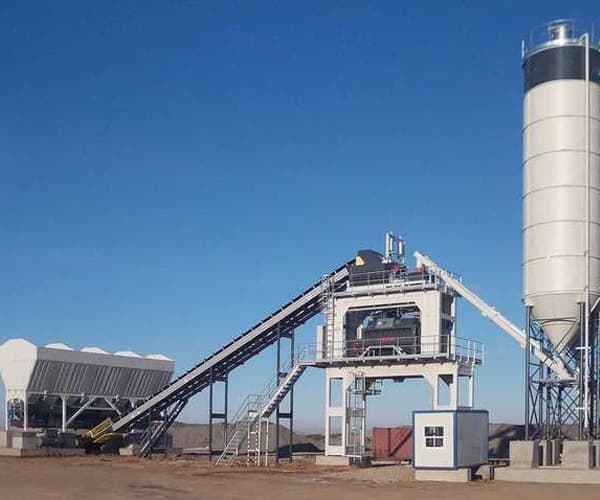
Belt type
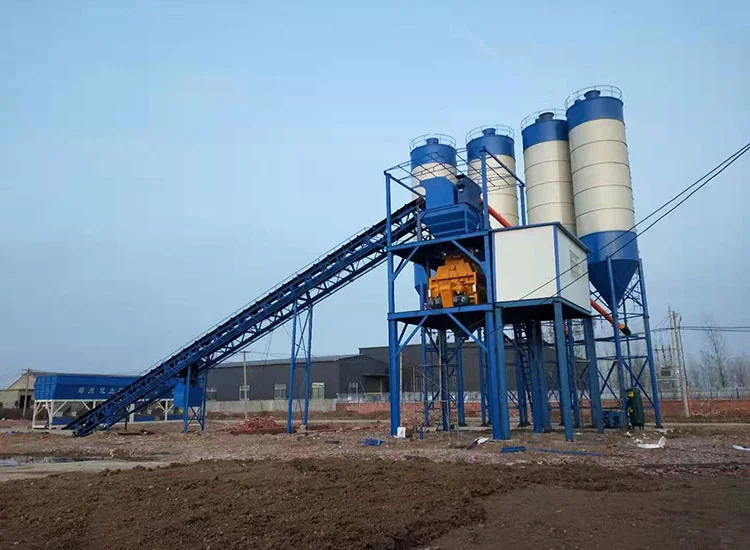
| HZS60 – HZS240 | Engineered for high-efficiency, large-scale production. The belt system ensures continuous aggregate feeding with high stability. Perfect for heavy-duty projects requiring 60m³/h to 240m³/h.
- High Efficiency: Continuous feeding significantly shortens the batch cycle time.
- Large Capacity: Ideal for high-volume demands (up to 240m³/h) and long-distance conveying.
- All-Weather Operation: Enclosed cover design protects aggregates from rain and dust.
(2) Mobile Ready Mix Concrete Plant
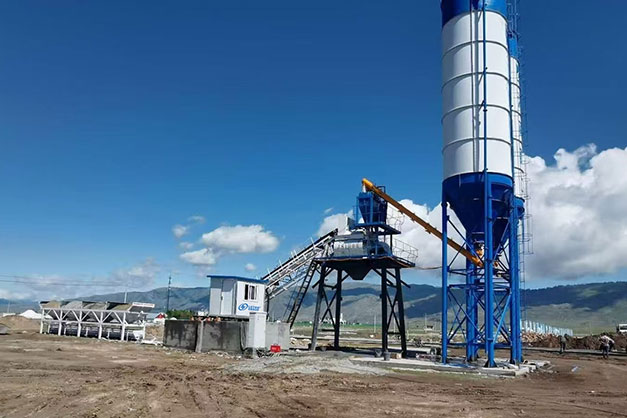
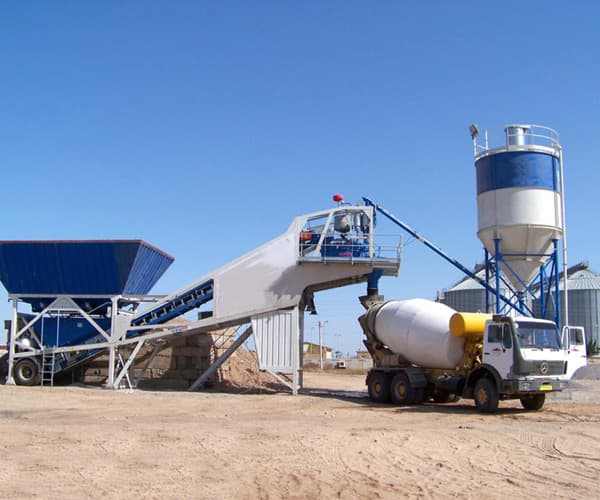
| YHZS25 – YHZS120 | Designed for maximum mobility. All core components are pre-wired on a transportable chassis, allowing for rapid assembly and relocation with zero civil foundation work required.
(3) Compact Concrete Batching Plant
Containerized Concrete Batching Plant
Features a modular, enclosed design for easy shipping and environmental protection. All components are integrated into standard container dimensions for quick assembly.
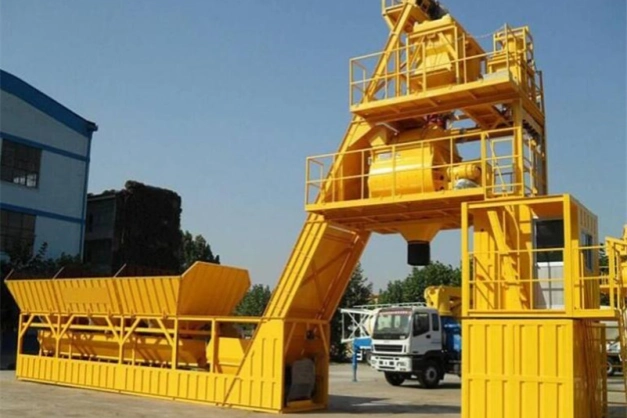
Foundation-Free Concrete Batching Plant
Requires no heavy civil foundation work. This design significantly reduces installation time and cost, making it ideal for temporary projects or sites with difficult ground conditions.
Parameters of Ready Mix concrete plant
There are many types of ready-mix plants, most of which are designed for specific locations or situations. If you are not sure how to choose which type of ready mix concrete plant, here are several effective references for you.
· site area
The mobile concrete batching plant covers a small area, suitable for projects with small construction areas;
The stationary concrete batching plant requires a larger footprint;
Compact concrete batching plant equipment is more compact and suitable for small construction projects.
· Installation and disassembly
Mobile concrete batching plants and compact batching plant installation and disassembly are more convenient, and mobile can be easily moved, compared to stationary concrete batching plants, stationary concrete batch plant installation time is longer, and once installed, it will be fastened in one place, and will not move.
Below are examples of parameters we provide you with stationary concrete batch plants, mobile concrete batch plants, and compact concrete batching plants.
Skip Hoist Concrete Batching Plant
| Type | HZS25 | HZS35 | HZS50 | HZS75 | HZS100 | HZS150 | HZS200 | |
| Theoretical Production Capacity(m3/h) | 25 | 35 | 50 | 75 | 100 | 150 | 200 | |
| Concrete Mixer | Type | JS500 | JS750 | JS1000 | JS1500 | JS2000 | JS3000 | JS4000 |
| Discharging capacity(L) | 500 | 750 | 1000 | 1500 | 2000 | 3000 | 4000 | |
| Aggregate size(Pebble/Macadam)(mm) | 80/60 | 80/60 | 80/60 | 80/60 | 80/60 | 80/60 | 80/60 | |
| Matched Aggregate Batcher | PLD800 | PLD1200 | PLD1600 | PL2400 | PLD3200 | PLD4800 | PLD6400 | |
| Weighing Accuracy | Aggregate (KG) | 1500Kg ±2% | 2000Kg ±2% | 3000Kg ±2% | 4500Kg ±2% | 4500Kg ±2% | 6000Kg ±2% | 9000Kg ±2% |
| Cement(KG) | 300Kg ±1% | 450Kg ±1% | 900Kg ±1% | 1500Kg ±1% | 1500Kg ±1% | 3000Kg ±1% | 3000Kg ±1% | |
| Fly ash(KG) | 500Kg ±1% | 600Kg ±1% | 600Kg ±1% | 600Kg ±1% | 1500Kg ±1% | 1500Kg ±1% | 1500Kg ±1% | |
| Water (KG) | 200Kg ±1% | 300Kg ±1% | 600Kg ±1% | 600Kg ±1% | 1000Kg ±1% | 1000Kg ±1% | 1000Kg ±1% | |
| Additive(KG) | 20Kg ±1% | 30Kg ±1% | 100Kg ±1% | 100Kg ±1% | 100Kg ±1% | 100Kg ±1% | 100Kg ±1% | |
| Discharging Height(M) | 3.8 m | 3.8 m | 3.8 m | 4.1m | 4.1m | 4.1m | 4.1m | |
Belt Conveyor Concrete Batching Plant
| Type | HZS60 | HZS90 | HZS120 | HZS180 | HZS240 | ||
| Theoretical Production(m³/h) | 60 | 90 | 120 | 180 | 240 | ||
| Concrete Mixer | Type | JS1000 | JS1500 | MAO3000/2000 | MAO4500/3000 | MAO6000/4000 | |
| Power(KW) | 18.5 | 65.5 | 74 | 110 | 150 | ||
| Discharging Capacity(L) | 1000 | 1500 | 2000 | 3000 | 4000 | ||
| Aggregate Size(Pebble/Macadam)(mm) | 80/60 | 80/60 | 80 | 150 | 150 | ||
| Aggregate Bin Volume(m³) | 2/3/4×8.38 | 2/3/4×12 | 2/3/4×20 | 2/3/4×30 | 2/3/4×40 | ||
| Belt Conveying Capacity(t/h) | 300 | 450 | 550 | 650 | 900 | ||
| Weighing Accuracy | Aggregate (KG) | 3000Kg ±2% | 4500Kg ±2% | 4500Kg ±2% | 6000Kg ±2% | 9000Kg ±2% | |
| Cement(KG) | 900Kg ±1% | 1500Kg ±1% | 1500Kg ±1% | 3000Kg ±1% | 3000Kg ±1% | ||
| Fly ash(KG) | 600Kg ±1% | 600Kg ±1% | 1500Kg ±1% | 1500Kg ±1% | 1500Kg ±1% | ||
| Water (KG) | 600Kg ±1% | 600Kg ±1% | 1000Kg ±1% | 1000Kg ±1% | 1000Kg ±1% | ||
| Additive(KG) | 100Kg ±1% | 100Kg ±1% | 100Kg ±1% | 100Kg ±1% | 100Kg ±1% | ||
| Discharging Height(M) | 4.1 m | 4.1m | 4.1m | 4.1m | 4.1m | ||
| Type | YHZS25 | YHZS35/40 | YHZS50/60 | YHZS75/90 | YHZS100/120 | |
| Theoretical Production Capacity(m3/h) | 25 | 35 | 50 | 75 | 100 | |
| Concrete Mixer | Type | JS500 | JS750 | JS1000 | JS1500 | JS2000 |
| Discharging Capacity(L) | 500 | 750 | 1000 | 1500 | 2000 | |
| Aggregate Size(Pebble/Macadam)(mm) | 80/60 | 80/60 | 80/60 | 80/60 | 80/60 | |
| Matched Aggregate Batcher | PLD800 | PLD1200 | PLD1600 | PL2400 | PLD3200 | |
| Weighing Accuracy | Aggregate (KG) | 1500Kg ±2% | 2000Kg ±2% | 3000Kg ±2% | 3000Kg ±2% | 3000Kg ±2% |
| Cement(KG) | 300Kg ±1% | 450Kg ±1% | 900Kg ±1% | 1500Kg ±1% | 1500Kg ±1% | |
| Fly Ash(KG) | Optional | |||||
| Water (KG) | 200Kg ±1% | 300Kg ±1% | 600Kg ±1% | 900Kg ±1% | 500Kg ±1% | |
| Additive(KG) | 20Kg ±1% | 30Kg ±1% | 30Kg ±1% | 50Kg ±1% | 100Kg ±1% | |
Modular type or container type
| Specifications | HZS-60C | HZS-90C | HZS-120C | HZS-180C |
| Theoretical Productivity (m3/h) | 60 | 90 | 120 | 180 |
| Mixer Discharging Volume (L) | 1000 | 1500 | 2000 | 3000 |
| Mixer Feeding Volume (L) | 1600 | 2400 | 3200 | 4800 |
| Mixer Motor Power (kW) | 18.5×2 | 30×2 | 37×2 | 55×2 |
| Discharging Height (m) | 4.1 | 4.1 | 4.3 | 4.3 |
| Aggregate Material Quantity (m3) | 7×4 | 15×4 | 15×4 | 20×4 |
| Cycle Period (s) | 60 | 60 | 60 | 60 |
| Max. Aggregate Size (mm) | 80/100 | 80/100 | 80/100 | 80/100 |
| Cement Silo (t) (optional) | 2×100 | 3×100 | 4×100 | 4×100 |
| Aggregate Weighing System | ±2% | ±2% | ±2% | ±2% |
| Powder Material Weighing System | ±1% | ±1% | ±1% | ±1% |
| Water Weighing System | ±1% | ±1% | ±1% | ±1% |
| Additive Weighing System | ±1% | ±1% | ±1% | ±1% |
| Installation Power (kW) | = 110 | = 160 | ^220 | ◎290 |
| Feeding Mode | Skip Hopper and Belt Conveyor | |||
| Control Mode | Full Automate Computer PC Control | |||
Free foundation type
| Specifications | FHZS-25 | FHZS-35 | FHZS-50 | FHZS-75 |
| Theoretical Productivity (m3/h) | 25 | 35 | 50 | 75 |
| Mixer Discharging Volume (L) | 500 | 750 | 1000 | 1500 |
| Mixer Feeding Volume (L) | 800 | 1200 | 1600 | 2400 |
| Mixer Motor Power (kW) | 18.5 | 30 | 18.5×2 | 30×2 |
| Aggregate Material Quantity (m3) | 3×3 | 5×3 | 8×3 | 12×3 |
| Cycle Period (s) | 60 | 60 | 60 | 60 |
| Max. Aggregate Size (mm) | 80/100 | 80/100 | 80/100 | 80/100 |
| Cement Silo (t) (optional) | 50×1 | 50×1 | 100×1 | 100×2 |
| Aggregate Weighing System | ±2% | ±2% | ±2% | ±2% |
| Powder Material Weighing System | ±1% | ±1% | ±1% | ±1% |
| Water Weighing System | ±1% | ±1% | ±1% | ±1% |
| Additive Weighing System | ±1% | ±1% | ±1% | ±1% |
Parameters are for reference only, please consult us for details.
Core Components of Ready Mix Concrete Plant
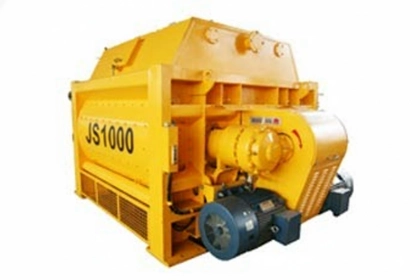
Mixer
Horizontal twin-shaft compulsory mixer has strong mixing ability, it can mix the materials evenly and effectively. It can mix concrete with different slumps and raw materials ratio. Its mixing blade and lining board are made of high chromium wear-resistant alloy. External shaft end support and special shaft seal ensure the long service life of the mixer. Planetary type mixer as an optional choice.
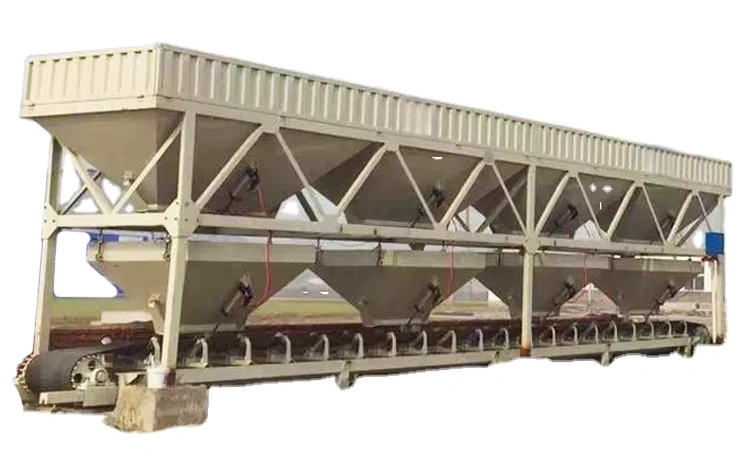
Batching Machine
High-volume operations require multi-compartment aggregate bins (typically 3 to 6 compartments). These units utilize industrial-grade pneumatic cylinders and precision load cells to rapidly measure sand and crushed stone.
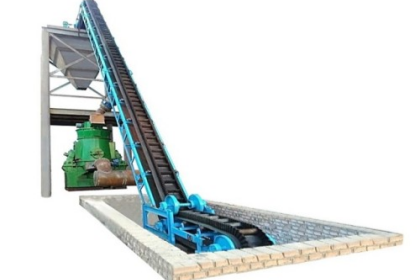
Aggregate Conveying System
After weighing, the aggregate is sent to the stationary concrete mixer by the lifting hopper or belt conveying system.
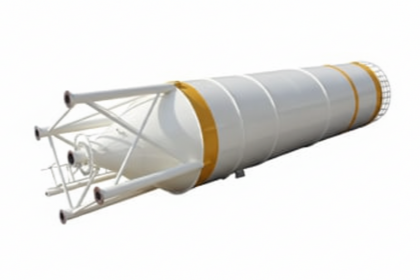
Material storage system
Used for storing aggregates, powdered materials (such as cement, fly ash), additives, etc. required for concrete production. Reasonable design, ensuring continuous and stable material supply, and improving production efficiency.
Including cement silo, aggregate silo, powder silo, etc., used to store different raw materials.
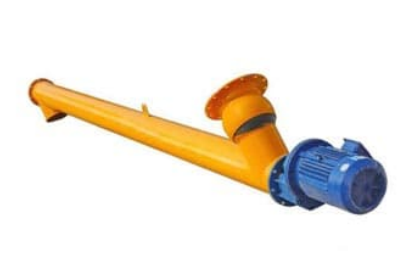
Screw Conveyor
Engineered for the dust-free and high-speed transport of cement and fly ash, our screw conveyors ensure a continuous and uniform material flow from silos to the weighing system.
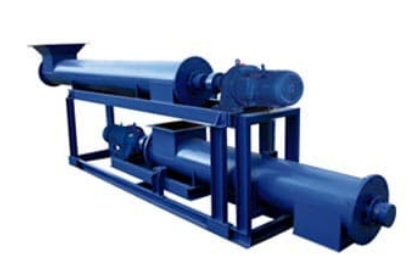
Powder and Liquid Weighing Scales
Suspended above the mixer, independent hoppers for cement, fly ash, water, and liquid additives ensure surgical precision. High-end ready mix concrete plant equipment features automatic difference compensation to maintain strict ±1% tolerances.
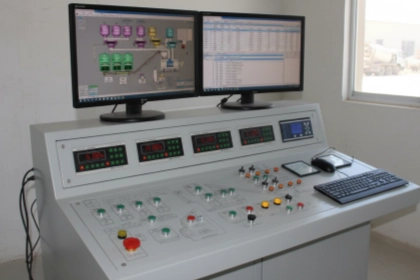
Automated Control Systems
The whole plant is controlled by industrial control computer. This system has the following features: real-time data processing function; both automatic and manual control are available; simple and convenient operation, for the automatic control system, The PLC is the world famous Germany Brand, the electric components are Schneider Brand from France. It can save all the data of the plant and the materials ratio; It can also print all the report forms. Constant temperature containerized type of control room adopts sound and heat insulation colorful batten board which can ensure the working temperature of electrical devices and also provide a comfortable environment for the operator.
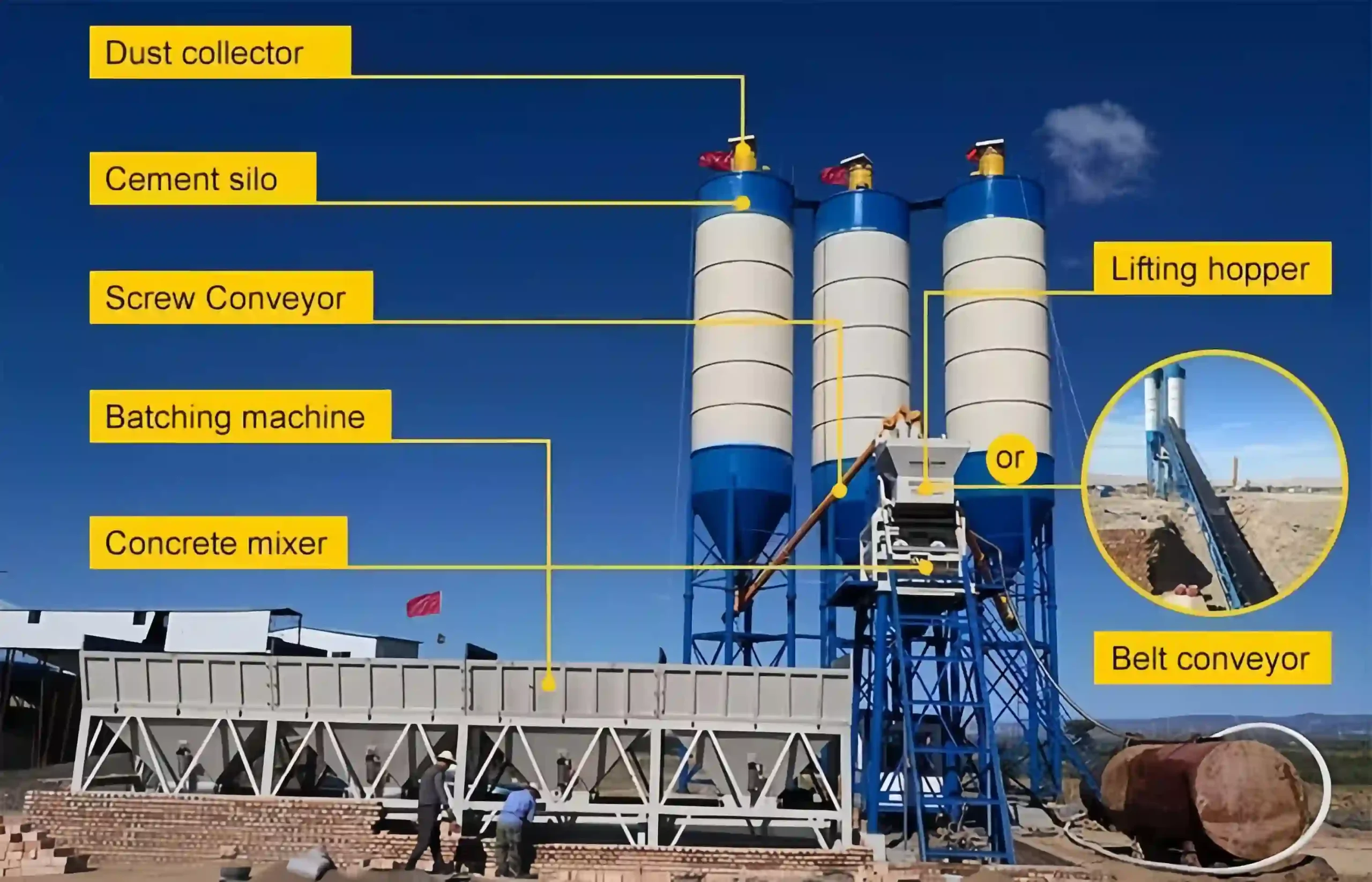
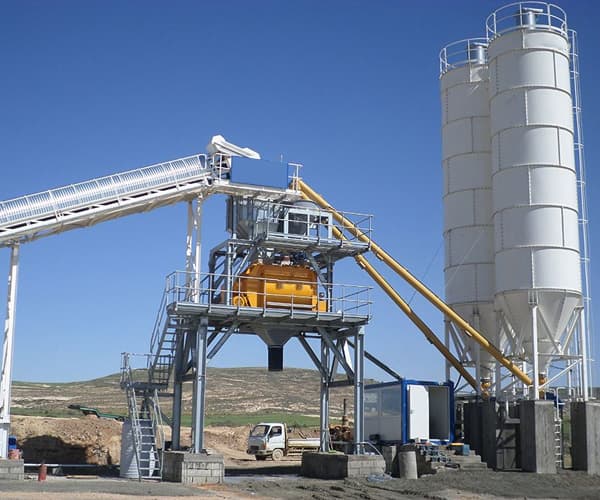
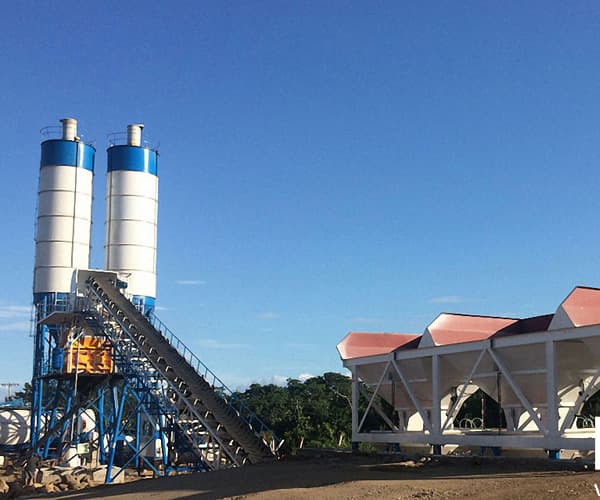
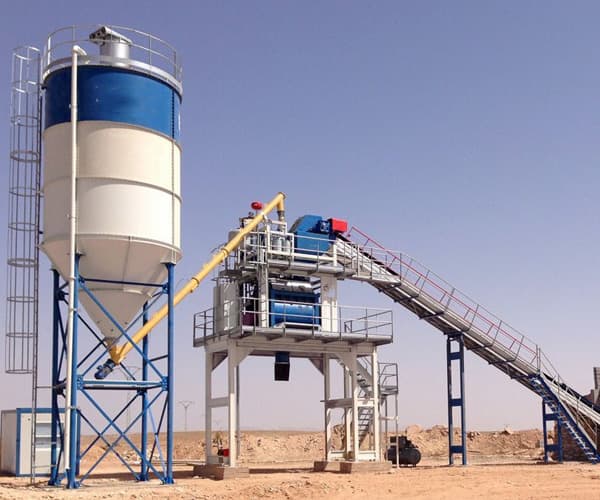
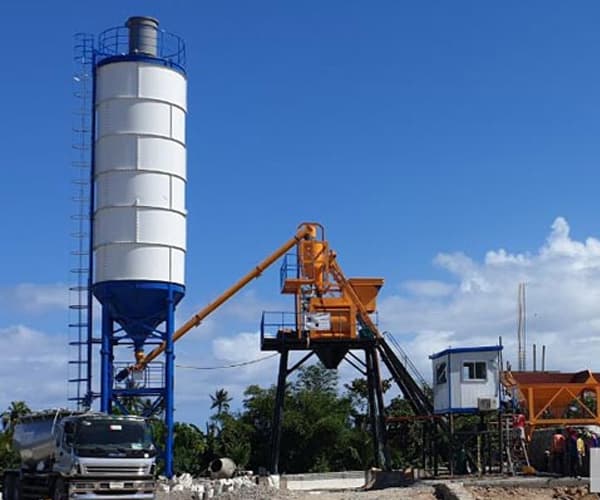
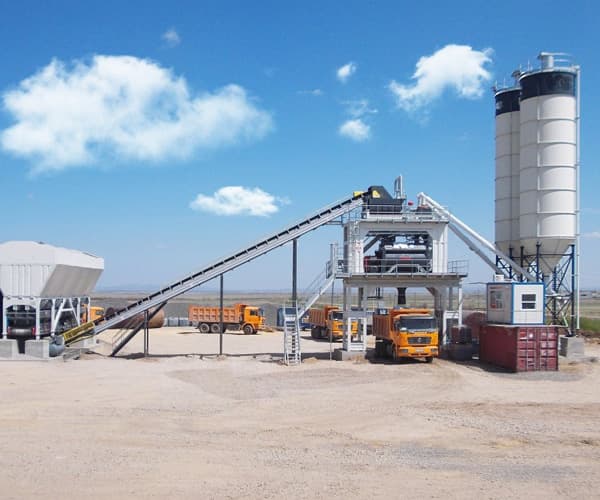
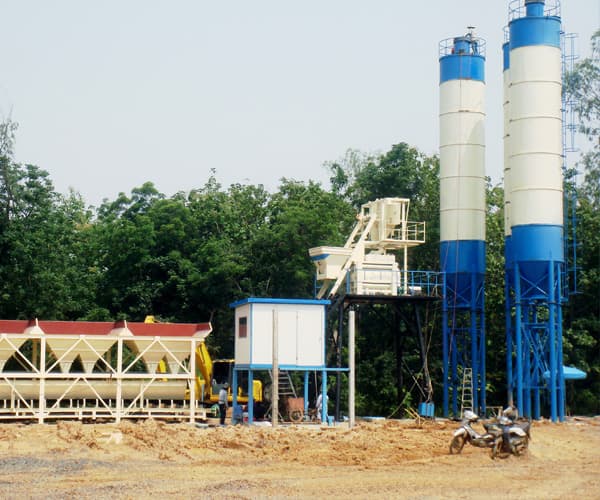
You can examine some photos of the product taken in our established facilities. For detailed information and references, you can contact our sales team by calling back or filling out the request form.
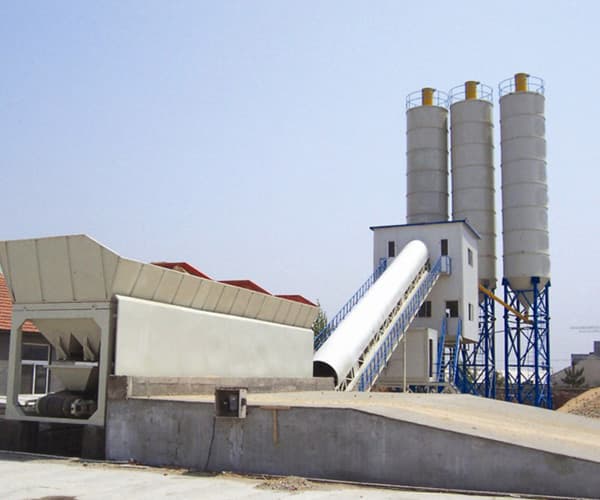
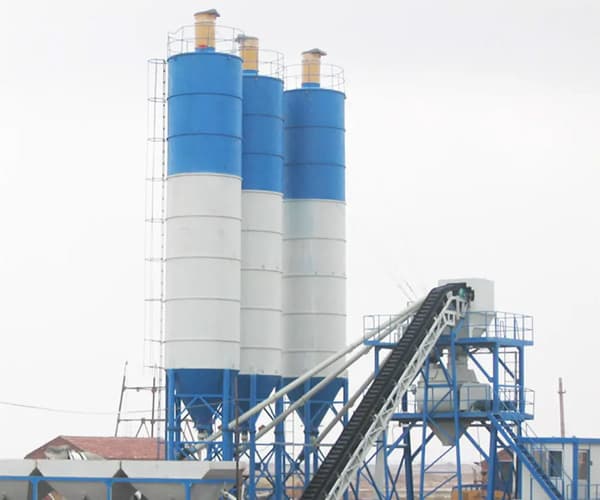
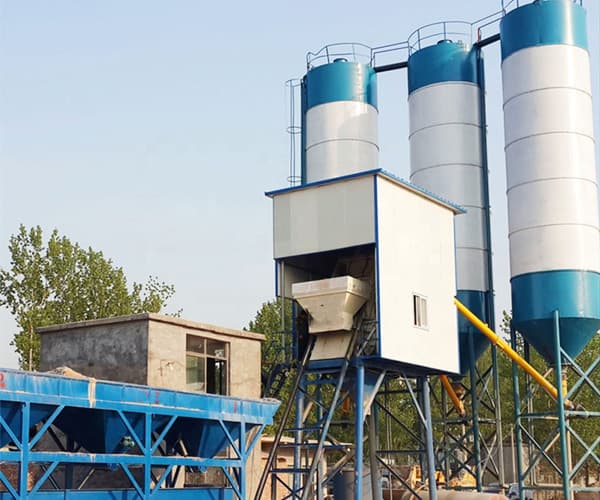
Key Features Of Ready mix Concrete Plant
Unlike standard systems, our plant discharges weighed liquid additives directly into the water weighing hopper first. This process ensures “secondary dissolution” of the additive before it enters the ready mix concrete mixer, resulting in a much more homogeneous concrete mixture.
The water discharge system utilizes a combination of a pneumatic butterfly valve and a booster pump. This design not only accelerates water discharge to shorten the batch cycle but also creates a high-pressure spray that effectively cleans the mixer shaft, preventing concrete buildup.
(For Belt Conveyor Models) Our HZS60 ready mix batching plant and larger models feature an Intermediate Waiting Bin located directly above the mixer. This allows the next batch of aggregates to be prepared and stored while the current batch is mixing, significantly eliminating wait times and boosting production speed.
(For Skip Hopper Models ) The loading bucket system is designed with a mechanical safety pin mechanism on the track. In addition to limit switches, this physical lock secures the bucket during maintenance, ensuring absolute safety for service personnel.
We optimize the ready mix concrete mixer discharge system based on plant capacity. Smaller models (HZS25-60) utilize fast-response pneumatic discharge, while larger models (HZS75+) are equipped with powerful hydraulic discharge systems to ensure stable gate operation and prevent jamming during high-volume production.
The weighing system employs industry-leading S-type tension sensors. Installed with a flexible suspension design, these sensors isolate the weighing hoppers from external vibrations, ensuring accurate measurement for cement, water, and aggregates.
Advantages of Ready mix Concrete Plant
Why choose a ready mix plant for your project? Our ready mix batching plants are engineered to deliver long-term value, combining robust construction with advanced technology to ensure maximum efficiency and profitability.
Significantly Increased Production Speed
Traditional on-site drum mixers typically yield only 4–5 m³/h. A commercial RMC plant provides a continuous output ranging from 25 to 240 m³ per hour. This steady capacity eliminates site bottlenecks and keeps large-scale projects strictly on schedule.
Versatile Mixer Options: Twin Shaft & Planetary
Furnished mainly with robust Twin Shaft Mixers, we also offer high-precision 0.5m³ and 1.5m³ Planetary Mixers. This flexibility makes our plants perfect for ready-mix producers, contractors, and especially precast manufacturers requiring superior homogeneity.
High-Performance Concrete Capability
Designed for demanding projects, our plants can easily integrate specialized systems for Ice, Microsilica, and various additives. This capability is critical for producing high-strength concrete for dams, ports, and other extreme engineering applications.
Precise Dosing & Material Savings
Automated weighing technologies continuously monitor and adjust batch parameters. By dispensing raw materials and admixtures with high accuracy, the plant can reduce cement consumption by 10% to 12% compared to manual methods, directly lowering material costs while maintaining the required concrete grade.
Heavy-Duty Structure & Durability
Built with high-strength structural steel and premium components, our plants are designed for continuous, high-intensity operation. The robust chassis ensures exceptional stability and longevity, significantly reducing long-term maintenance costs.
Ultimate Modular Design & Flexibility
Our ultimate modular design allows for easy transportation and quick installation and provides the flexibility to adapt to complex site conditions and add features as per project requirements. Whether you need to expand capacity or adjust the layout, we offers scalable solutions for your business growth.
Automated Control & Labor Reduction
Integrated PLC control systems require minimal manual intervention. A single trained operator can oversee the entire batching and mixing workflow from the control cabin, which optimizes your payroll and eliminates variances caused by human fatigue.
Eco-Friendly & Safe Maintenance
Designed with advanced dust collection systems and noise reduction technology to meet environmental regulations. Spacious service platforms and safety walkways ensure easy access for maintenance, minimizing downtime and enhancing operator safety.
The Ready Mix Concrete Plant Business Plan & Cost Analysis
Breakdown of the Total Setup Cost (The Project Report)
A common mistake new investors make is confusing the machinery price with the ready mix concrete plant setup cost. To launch a highly profitable commercial enterprise, your initial business plan must account for a comprehensive list of Capital Expenditures (CApEx).
Whether you are drafting a ready mix concrete plant project report for bank financing or personal investment, here is a detailed breakdown of the total costs you must budget for:
Land Acquisition & Civil Foundation Works
A commercial facility requires space. You will need roughly 1,500 to 3,000 square meters of land for the plant, aggregate stockpiles, and truck maneuvering.
The Investment
Beyond leasing or buying the land, a significant portion of your budget goes into pouring massive, reinforced concrete foundations to support the heavy mixing tower and cement silos. Site leveling, drainage systems, and building retaining walls for aggregate bins are also major expenses.
The Logistics & Delivery Fleet
In the commercial concrete business, the delivery fleet often costs more than the batching machinery itself.
The Investment
You must purchase or lease a minimum of 3 to 5 transit mixer trucks to ensure continuous delivery. Additionally, at least one heavy-duty wheel loader is required on-site to constantly feed sand and gravel into the batching machine.
Initial Working Capital
Before your first invoice is paid, you must procure raw materials.
The Investment
Your RMC plant costing model must include a reserve fund (typically 2 to 3 months of operating capital) to purchase bulk cement, crushed stone, sand, chemical additives, and diesel fuel, as well as to cover initial payroll for operators and drivers.
Environmental Compliance & Utility Access
Securing the necessary permits to operate a heavy industrial plant in an urban area requires adherence to strict regulations.
The Investment
Budget for industrial-grade electricity transformers, high-volume water supply pipelines, and concrete washout (recycling) basins. Furthermore, many municipalities require the installation of active pulse-jet dust collectors and noise-dampening cladding to pass environmental inspections.
Cost Proportions & Key Drivers
Investing in a commercial ready mix concrete plant requires evaluating more than just the upfront equipment price. A highly profitable business model balances the initial Capital Expenditure (CapEx) with long-term Operational Expenditure (OpEx), component reliability, and automation efficiency to maximize the Return on Investment (ROI).
Proportional Breakdown of Total Investment
When planning your project budget, expenses can generally be categorized into four main areas. It is important to note that investing heavily in high-quality equipment initially (higher CapEx) often creates a more predictable and efficient cost structure over the plant’s lifecycle.
- Capital Expenditure (CapEx) – 50% to 60%: The core machinery, including the mixing unit, aggregate batchers, cement silos, conveyors, and automated control systems.
- Site Preparation & Installation – 10% to 15%: Civil engineering for robust concrete foundations, land leveling, power supply access, and on-site assembly.
- Operating Expenditure (OpEx) – 25% to 35%: The daily recurring costs, including raw materials, electricity, fuel, labor payroll, and routine wear parts.
- Indirect & Contingency Costs – 5% to 10%: Regulatory compliance permits, operator training, and reserve funds for unforeseen expenses.
Key Drivers of Plant Costs
Your specific project requirements will influence how these costs are distributed:
- Plant Type and Capacity: Stationary, high-capacity facilities (120–240 m³/h) demand deep foundations and larger silos, leading to higher initial costs but offering massive continuous output. Alternatively, mobile or compact units reduce site preparation expenses by 10% to 20% due to their foundation-free designs.
- Component Durability: Selecting premium mixers with high-chromium wear liners increases the upfront price but significantly lowers long-term maintenance costs and prevents expensive production halts.
- Automation Level: Upgrading to an intelligent PLC system with real-time monitoring demands higher initial investment but dramatically reduces operational inefficiencies.
Maximizing Your Return on Investment (ROI)
The true value of a ready mix concrete plant lies in its efficiency gains. An advanced, automated facility directly accelerates your payback period through several operational savings:
- Material Efficiency: High-precision weighing sensors and automatic moisture compensation reduce raw material waste (especially expensive cement) by 10% to 20%.
- Labor Optimization: A centralized, automated batching process requires minimal manual intervention, reducing on-site staffing requirements by 30% to 50%.
- Predictive Maintenance: Tracking operating hours and component wear via smart software can reduce unexpected mechanical failures by up to 40%, ensuring higher utilization rates.
Illustrative Payback Scenario
Consider a medium-capacity facility producing approximately 560 m³ of concrete per day over a standard 8-hour shift. By leveraging the material savings and reduced labor overhead provided by automated systems, the facility generates a highly consistent daily gross margin. Depending on local market demand and concrete selling prices, most professional operators achieve a full ROI within 1 to 3 years, transforming the initial setup expense into a powerful engine for long-term business growth.
How to Choose the Right ready mix Concrete Plant for Your Project
Selecting the ideal ready mix concrete plant is critical for ensuring operational efficiency, consistent material quality, and a rapid return on investment. To make the most informed decision, investors must align their equipment choice with actual production demands, site constraints, and long-term business goals. Consider these four essential factors before making a purchase:
Align Plant Capacity with Daily Production Goals
Do not guess your capacity requirements. Base your decision on your target daily output.
- Low-Volume Operations (<400 m³/day): For rural development or small residential projects, a compact plant (25–50 m³/h) is highly cost-effective and easy to operate with a limited crew.
- Mid-Volume Commercial Supply (400–1,000 m³/day): For standard commercial supply or mid-sized infrastructure, a medium-capacity plant (60–90 m³/h) provides the perfect balance between continuous output and manageable upfront investment.
- High-Volume Mega-Projects (>1,000 m³/day): Supplying highways, high-rise clusters, or airport runways requires heavy-duty, large-capacity facilities (120–240 m³/h+) to ensure continuous pouring without supply bottlenecks.
Evaluate Site Conditions and Mobility Needs
Your business model and available land dictate the structural type of the plant.
- Permanent Commercial Hubs: If you are establishing a long-term business in a fixed location with ample space, a stationary plant is the superior choice. It offers maximum stability and storage capacity but requires robust civil foundations.
- Frequent Relocation: If your strategy involves following highway construction or moving between remote sites every few months, a mobile configuration is essential. These units can be dismantled and relocated within days, significantly reducing downtime and logistics costs.
Prioritize Quality Control and Automation
Selling commercial concrete requires strict adherence to engineering standards.
A professional ready mix concrete plant must be equipped with a fully automated PLC control system. High-level automation eliminates human error, guarantees exact batch-to-batch uniformity, and allows operators to adjust mix designs in real-time to meet the diverse requirements of different clients.
Balance Budget with Future Scalability
While a smaller setup requires lower initial capital, it may limit your ability to secure highly lucrative, large-volume contracts in the future. Look for manufacturers that offer modular designs. This allows you to expand your operation—such as adding more cement silos or expanding aggregate bins—as your business grows, without the need to replace the entire system.
Application Scenarios and Customized Solutions for ready mix Concrete Plant
Our ready mix concrete plants are engineered to adapt to the varied needs of modern construction. By tailoring configurations and control strategies, we ensure reliable, efficient concrete production for every project type.
Transportation Infrastructure
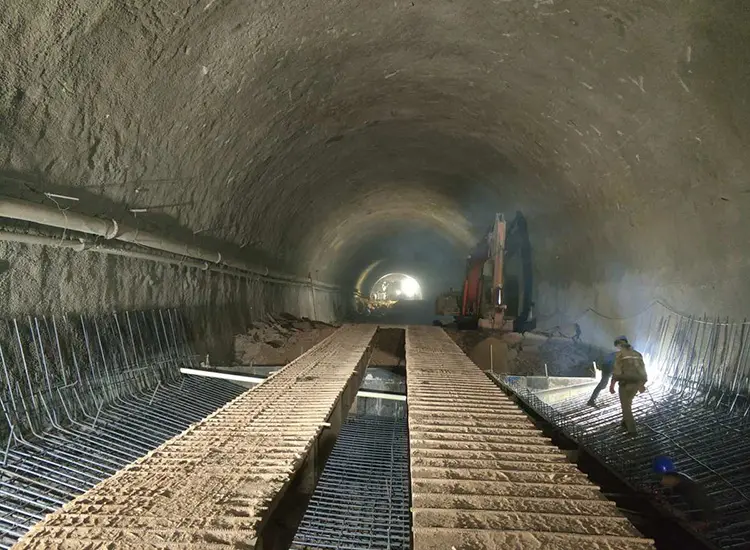
- Typical Applications: Highways, railways, bridges, tunnels, airports.
- Core Requirements:
- Production of High-Strength Concrete (C50+) with strict durability standards.
- Continuous, high-capacity output for large-scale paving.
- Recommended Solution:
- Large-Capacity HZS Series (120m³/h+): Equipped with Twin-Shaft Mixers for rapid, homogeneous mixing.
- High-Precision Dosing: Advanced aggregate batching ensures consistent quality for critical load-bearing structures.
Hydraulic & Marine Engineering
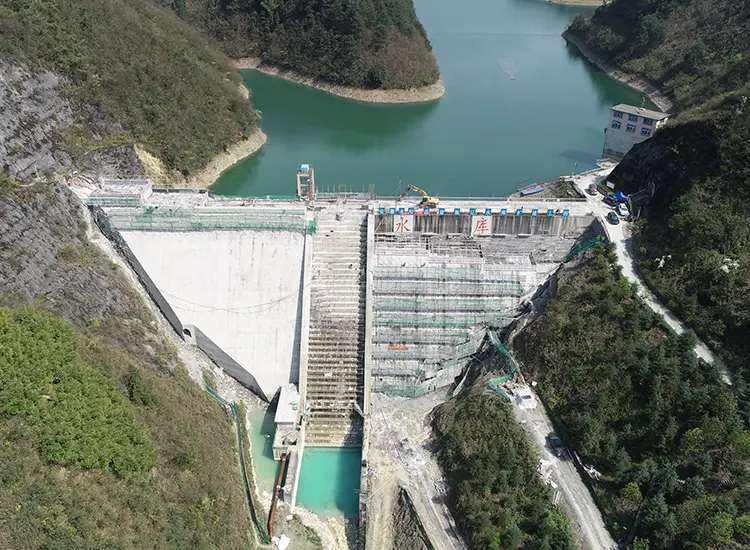
- Typical Applications: Dams, hydropower stations, ports, state defense projects.
- Core Requirements:
- Mass Concrete Production (e.g., RCC) with low heat of hydration.
- Resistance to erosion and corrosion in harsh environments.
- Recommended Solution:
- Specialized Additive Integration: Built-in systems for Ice and Microsilica dosing to control concrete temperature and durability.
- Weather-Resistant Design: Fully enclosed structure with anti-corrosion coating for long-term outdoor operation.
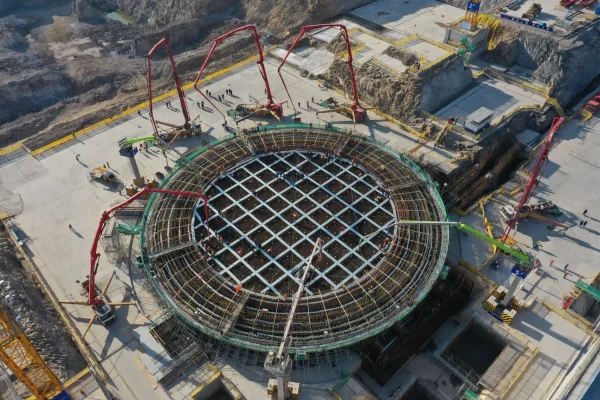
Nuclear Power & Energy Facilities
- Typical Applications: Reactor containment buildings, radiation-shielding structures.
- Core Requirements:
- Production of ultra-high-density, radiation-proof concrete.
- The highest levels of safety and strict quality control.
- Recommended Solution:
- Fail-Safe Automation: Dual-redundant control systems ensuring flawless batching for critical safety mixes.
- Heavy-Duty Weighing: Upgraded load cells designed to accurately handle dense shielding aggregates.
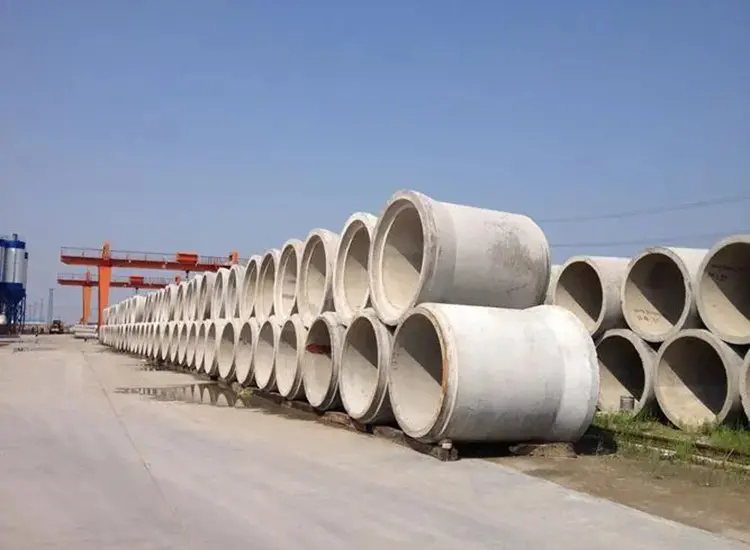
Precast Concrete Manufacturing
- Typical Applications: Concrete pipes, hollow core slabs, tunnel segments, municipal elements.
- Core Requirements:
- High-Precision (±1%) weighing for standardized components.
- Uniform mixing of zero-slump (dry) and plastic concrete.
- Recommended Solution:
- Planetary Mixer Option: Ensures superior homogeneity for high-quality precast elements.
- Automated Production Integration: Seamlessly connects with precast production lines for synchronized operation.
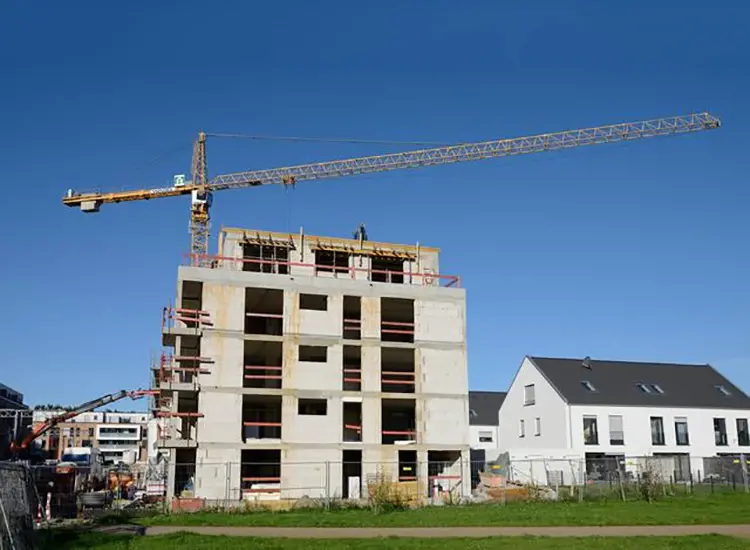
Commercial & Residential Construction
- Typical Applications: Housing projects, commercial complexes, industrial facilities.
- Core Requirements:
- Stable production of normal-strength concrete (C20–C40).
- Cost-effectiveness and high ROI.
- Recommended Solution:
- Flexible Modular Design: Rapid installation and easy relocation for varying project phases.
- Optimized Cost Control: Efficient material usage and low maintenance design maximize profitability for ready-mix suppliers.
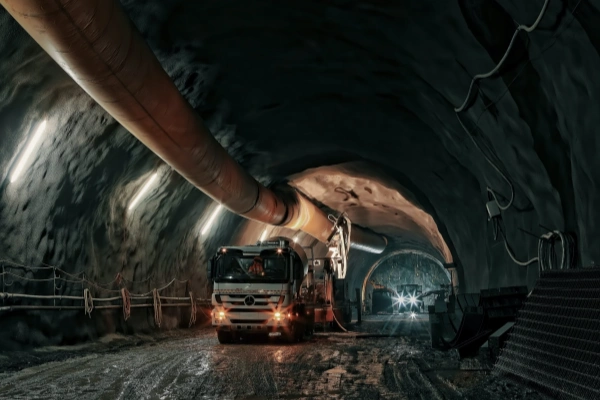
Mining & Underground Backfilling
- Typical Applications: Mine shaft filling, underground void stabilization.
- Core Requirements:
- Specialty concrete with quick-setting, high-flowability, and self-compacting qualities.
- Continuous, stable output for underground delivery.
- Recommended Solution:
- Specialized Dosing Systems: Precise integration of accelerators and superplasticizers to control flow rates.
- High-Throughput Output: Continuous batching designs optimized for seamless concrete pumping operations.
Our ready mix Concrete Plants In Action
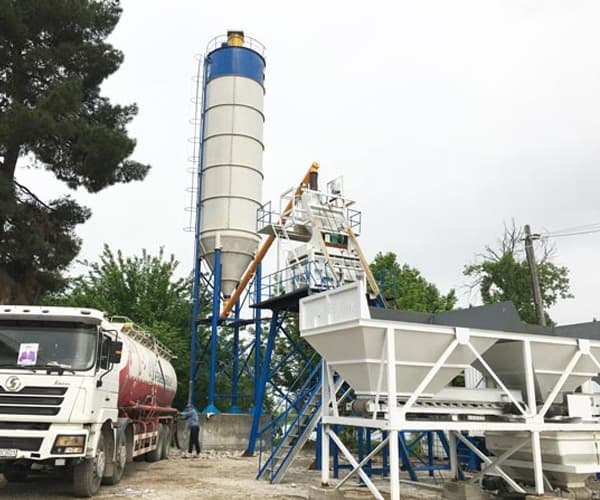
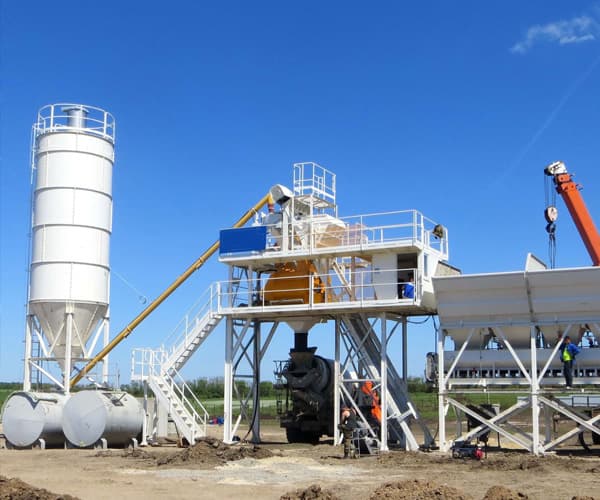
Ready Mix Concrete Plant in Malaysia
Ready Mix Concrete Plant in Australia
Ready Mix Concrete Plant in Canada
Why CCS is Your Trusted Ready Mix Concrete Plant Manufacturer
As a specialized concrete batching plant manufacturer with over 32 years of global experience, CCS does not just sell steel; we deliver long-term industrial profitability. Our commitment to factory-direct quality makes us the preferred partner for contractors in Philippines, India, Saudi Arabia, Australia, and beyond.
Partner with CCS for a “Turnkey” Success:
- Factory-Direct Value: We eliminate the 20%-40% markup of middlemen concrete plant suppliers, delivering premium global components (Siemens, Schneider) at true factory pricing.
- Global Technical Backbone: We provide complete project support, from 3D site layout planning and foundation drawings to expert-led installation supervision and 24/7 remote software diagnostics.
- Optimized ROI: Our engineering philosophy is simple: build plants that waste less cement, consume less energy, and require less maintenance. We help you achieve full capital recovery within 8 to 12 months.
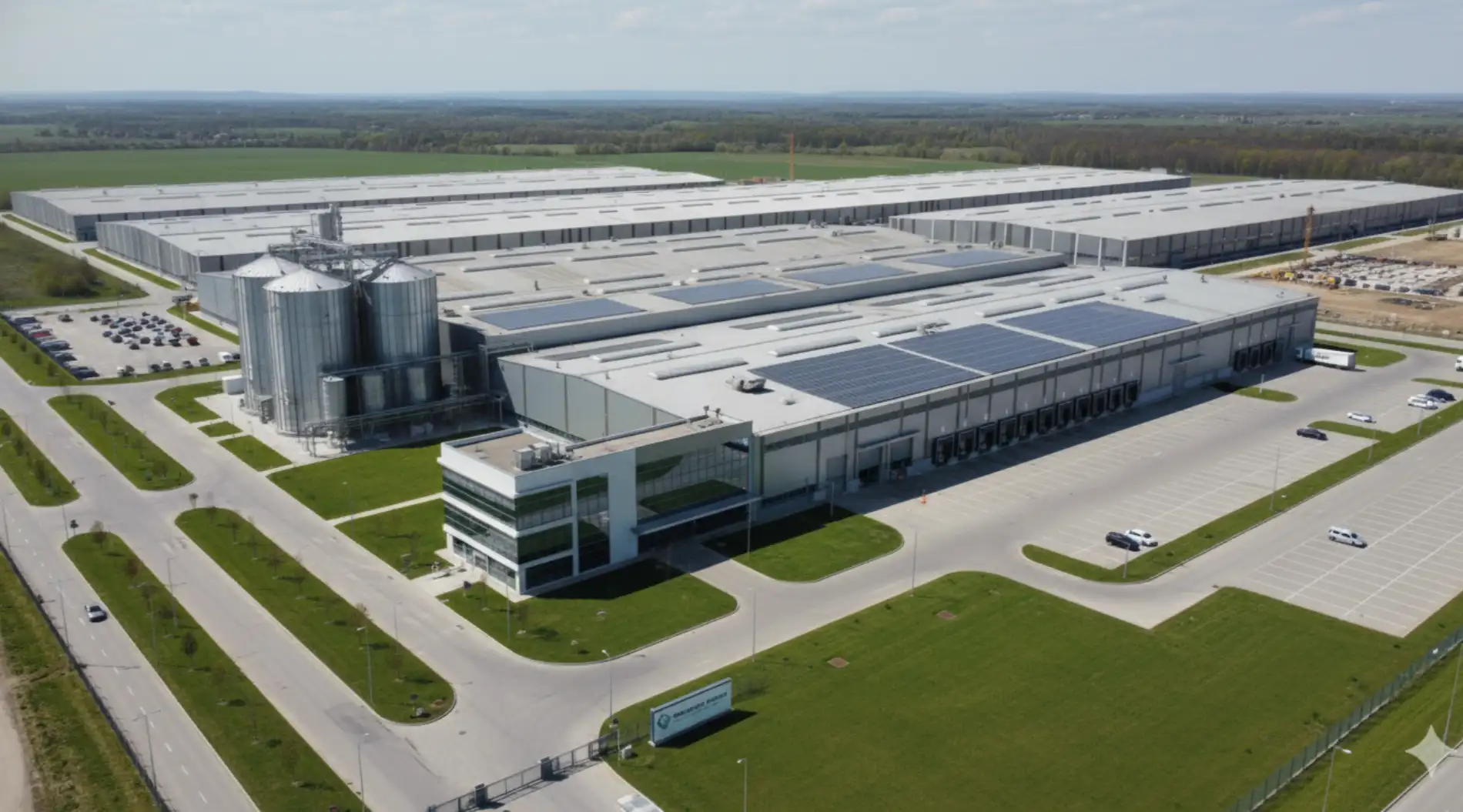

As a full-service organization, our commitment to your success extends far beyond the sale. We provide an end-to-end support system designed to maximize your Return on Investment (ROI).
Pre-Sales Engineering & Investment Consulting
Expert Installation & Operational Training
24/7 After-Sales Support & Maintenance
💡Expert Insights: Navigating ready mix Concrete Plant
What is a Ready Mix Concrete Plant?
For entrepreneurs and contractors entering the heavy construction materials sector, the most foundational question is often: what is ready mix concrete plant technology, and how does it differ from traditional site mixing?
A ready mix concrete plant (widely abbreviated as an rmc plant) is a centralized, highly automated industrial facility. It is engineered to precisely weigh and combine raw materials—such as aggregates, cement, water, and chemical admixtures—into a homogeneous concrete mixture. Once mixed, this commercial-grade product is discharged into transit mixer trucks and delivered “just-in-time” to various construction sites.
The defining advantage of an automated ready mix concrete batching plant is its uncompromising quality control. While manual mixing is prone to human error, a professional facility ensures every cubic meter meets the rigorous, high-strength standards demanded by modern infrastructure projects. Furthermore, investing in these facilities allows suppliers to manage hundreds of custom mix designs, simultaneously serving multiple independent contractors with absolute consistency.
Core Machinery & Equipment of an RMC Plant
The long-term profitability of a commercial concrete business relies entirely on the durability and accuracy of its hardware. A high-performance facility requires robust ready mix concrete plant machinery designed for continuous, heavy-duty operation without unscheduled downtime.
When evaluating a system, investors must understand the specific components of ready mix concrete plant configurations that drive efficiency:
- The Central Mixing Unit: This is the heart of the operation. Most commercial facilities utilize heavy-duty twin-shaft compulsory mixers, providing the high-shear agitation necessary for rapid, homogeneous mixing. For specialized precast applications requiring zero-slump concrete, planetary mixers are often employed.
- Aggregate Batching Systems: High-volume operations require multi-compartment aggregate bins (typically 3 to 6 compartments). These units utilize industrial-grade pneumatic cylinders and precision load cells to rapidly measure sand and crushed stone.
- Powder and Liquid Weighing Scales: Suspended above the mixer, independent hoppers for cement, fly ash, water, and liquid additives ensure surgical precision. High-end ready mix concrete plant equipment features automatic difference compensation to maintain strict ±1% tolerances.
- Automated Control Systems: Modern facilities are governed by an intelligent PLC (Programmable Logic Controller) interface. Housed in a climate-controlled cabin, this software logs daily material consumption, prevents operator errors, and allows a single technician to oversee the entire production cycle smoothly.
Why “Ready Mix”?
Ready-mix concrete refers to freshly mixed concrete that is centrally batched and sold as a commercial product. Compared to on-site mixing, it offers more stable quality. It is called “ready-mix” because it is not used directly at the production site but is transported to the construction site by concrete trucks.
How Does a ready mix Concrete Plant Work? (Working Principle)
The operation of a ready mix batching plant is a highly synchronized process governed by an automated PLC control system. The entire workflow can be broken down into five precise steps: from raw material storage to the discharge of fresh concrete.
Step 1: Material Storage & Feeding
Different types of aggregates (sand, gravel) are loaded into separate compartments of the aggregate batcher using a wheel loader. Simultaneously, bulk cement and fly ash are stored in sealed silos, while water and liquid additives are kept in dedicated tanks.
Step 2: Precise Weighing & Batching
Once the operator inputs the required concrete recipe into the control panel, the automated weighing process begins:
- Aggregates: Discharged via pneumatic gates and weighed precisely on a load-cell-suspended conveyor belt or hopper.
- Powders (Cement/Fly Ash): Conveyed via screw conveyors into independent weighing scales above the mixer.
- Water & Additives: Pumped into individual liquid scales. For better homogeneity, our plants often pre-mix additives with water (secondary dissolution) before they enter the mixer.
Step 3: Conveyance to the Mixer
Once all materials reach their exact target weights, they are transferred to the central mixing unit. Aggregates travel up an inclined belt conveyor (or a skip hoist bucket), while powders and liquids drop directly from their scales via gravity and pressurized pumps.
Step 4: Homogeneous Mixing
The heart of the plant, typically a Twin-Shaft or Planetary mixer, combines all the dry and wet ingredients. The mixer’s powerful blades aggressively agitate the materials for a set duration, ensuring a completely homogeneous mixture with the desired strength and workability.
Step 5: Discharge & Transport
Upon completion of the mixing cycle, the mixer’s bottom discharge gate opens pneumatically or hydraulically. The fresh concrete drops directly into a waiting transit mixer truck or a concrete pump hopper, ready to be delivered to the construction site.
Ready Mix Concrete Plant Layout & Diagram
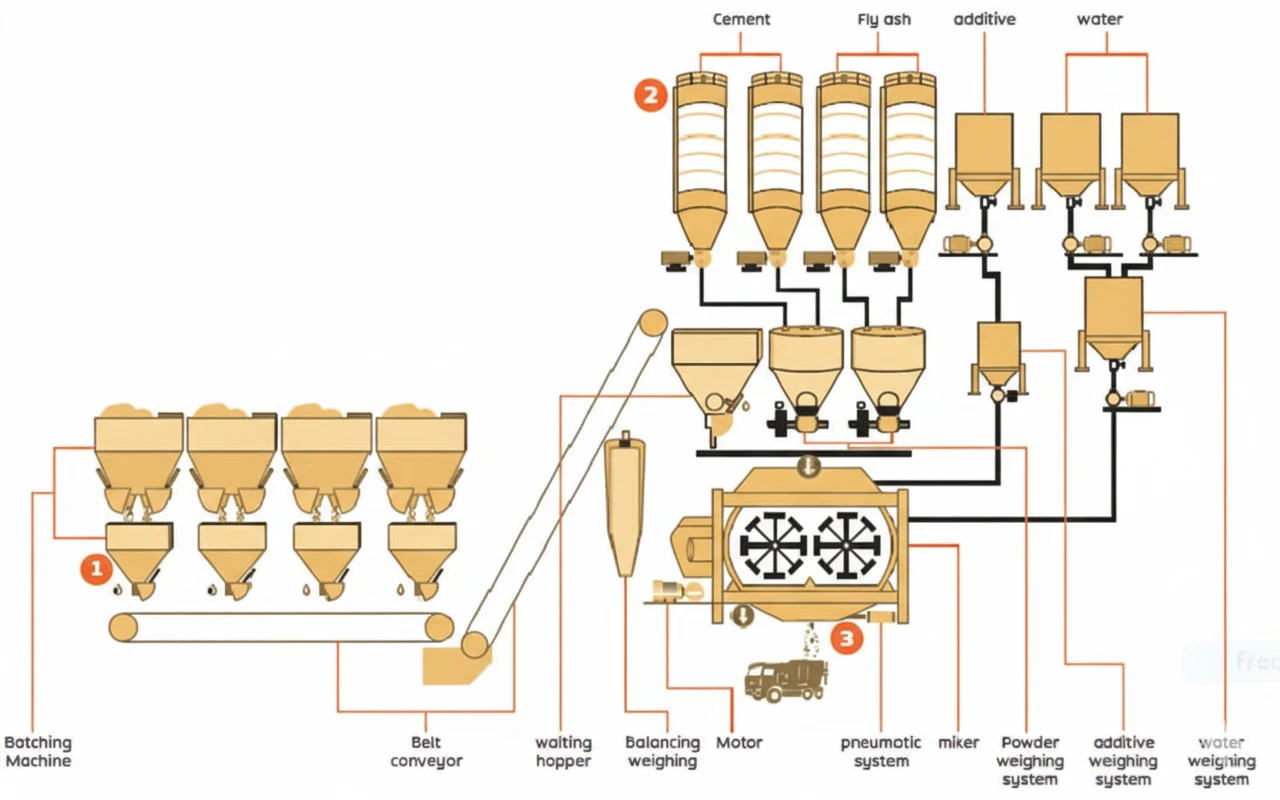
Designing an efficient ready mix concrete plant layout is just as critical as selecting the machinery itself. A poorly planned site can lead to traffic bottlenecks for transit mixers, slow raw material replenishment, and ultimately, a decrease in your daily concrete output.
Whether your facility is located in a congested urban area or a spacious industrial park, the spatial arrangement must prioritize continuous material flow and safe vehicle movement.
Core Zones in a Standard Plant Diagram
When reviewing a ready mix concrete plant diagram, you will typically see the site divided into four distinct operational zones:
- The Main Mixing Tower: Located at the center of the operation, this structure supports the weighing hoppers and the central mixer. The discharge gate height is critical—it must provide sufficient clearance (typically 3.8m to 4.1m) for mixer trucks to drive underneath smoothly.
- Aggregate Storage & Feeding Zone: Positioned behind or adjacent to the mixing tower. In a belt-conveyor layout, this zone requires a longer footprint (up to 40-50 meters) to accommodate the 18-degree incline of the main belt.
- Cement Silo Farm: Tall, cylindrical storage silos are grouped together. A well-designed layout places them close to the mixing tower to keep screw conveyors short, reducing wear and energy consumption.
- Traffic & Logistics Loop: The most vital aspect of the design. A professional plant layout ensures a one-way, circular traffic flow for transit mixers, completely separate from the heavy wheel loaders feeding the aggregate bins.
Choosing the Right Layout Shape
Professional manufacturers typically offer highly adaptable configurations to maximize the area required for an RMC plant:
- Linear (In-Line) Layout: The aggregate bins, conveyor belt, and mixing tower are aligned in a straight line. This is the industry standard for high-capacity plants, offering the most straightforward material flow.
- L-Shaped or T-Shaped Layout: If the plot of land is wide but lacks depth, the aggregate feeding system can be positioned at a 90-degree angle to the mixing tower. This modular flexibility ensures the plant can fit into unconventional land boundaries without compromising production speed.
How to Choose: Stationary vs. Mobile ready mix Concrete Plant?
Deciding between a stationary and a portable concrete batching plant is one of the most critical choices for any contractor or ready-mix supplier. Both types serve the same primary function—producing high-quality concrete—but they are engineered for very different operational models. To make the right decision, you must evaluate your project’s duration, production volume, and relocation frequency.
Key Differences to Consider
Project Duration & Relocation
Choose Stationary If: Your project (like a large dam, airport, or precast factory) will last for several years in a single location, or if you are setting up a commercial ready-mix business. Stationary plants require robust concrete foundations, making them harder to move but incredibly stable for long-term use.
Choose Mobile If: You are working on short-term projects (like road construction or wind farms) that require the plant to be moved every few months. Mobile plants are pre-wired on a wheeled chassis, allowing for rapid deployment and installation without massive civil foundation work.
Production Capacity
Stationary Advantage: They are built for high-volume output. Our stationary plants can achieve capacities up to 240 m³/h. With larger aggregate bins, bigger twin-shaft mixers, and wider conveyor belts, they handle continuous, heavy-duty production flawlessly.
Mobile Limitation: Due to chassis weight and size restrictions for road transport, mobile plants generally max out around 120 m³/h. Their aggregate storage capacity is also typically smaller, requiring more frequent refilling by wheel loaders.
Initial Cost vs. Long-Term ROI
Stationary Plants: The initial setup cost is higher due to extensive foundation construction, site preparation, and longer installation times. However, for long-term projects, the lower maintenance costs, higher efficiency, and greater durability result in a significantly better Return on Investment (ROI) and a lower cost-per-cubic-meter over time.
Mobile Plants: Offer lower upfront installation costs and immediate production capabilities. They are highly cost-effective for contractors who need to frequently change sites, saving heavily on transport and re-erection expenses.
Our Recommendation
Invest in a Stationary Plant if you are building a permanent commercial ready-mix facility, a precast components factory, or supplying a multi-year mega-project where maximum capacity and unyielding stability are non-negotiable.
Opt for a Mobile Plant if agility is your priority and your business model relies on moving from one medium-sized construction site to the next.
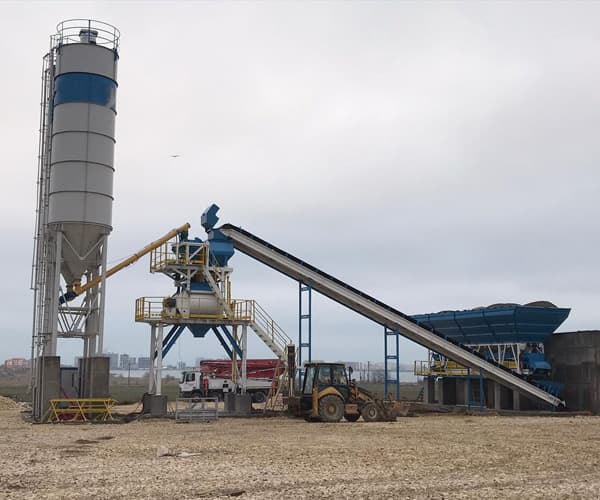
Ready Mix Concrete Plant vs. On-Site Mixing
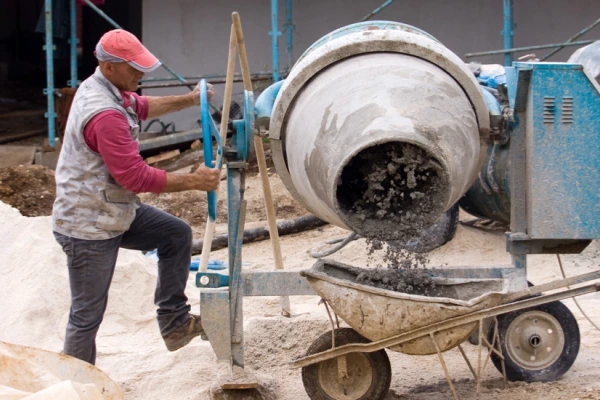
When planning a construction project, deciding between sourcing from a centralized ready mix concrete plant and relying on traditional on-site mixing significantly impacts your budget, timeline, and structural quality. Below is an objective comparison to help guide your decision:
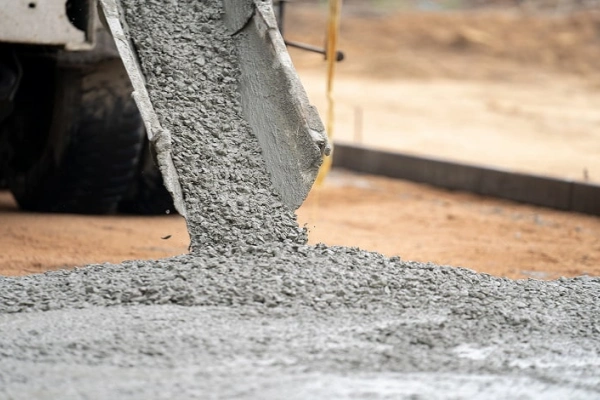
VS
| RMC Plant | Type | Onsite Mixing |
|---|---|---|
| Utilizes automated batching systems and precision load cells. Materials are weighed in a controlled environment, ensuring strict adherence to mix designs and consistent quality across every batch. | Quality Control and Consistency | Relies heavily on manual loading and operator experience. Moisture levels and material ratios are harder to control, resulting in a higher risk of strength variability and rework. |
| Engineered for continuous, high-volume output. Once the logistics chain is established, it can supply hundreds of cubic meters per day, keeping large-scale projects strictly on schedule. | Production Volume and Turnaround | Output is restricted by the small capacity of drum mixers. It is suitable for quick setups but struggles to meet the demands of continuous, large-scale concrete pours. |
| Centralized production reduces on-site labor requirements and eliminates the need to rent multiple small mixers. Optimized batching algorithms also minimize raw material leftovers and disposal fees. | Cost Efficiency and Material Waste | Requires a larger manual workforce to handle cement bags and aggregates. Unused or improperly mixed materials often lead to higher wastage rates on the job site. |
| Requires careful coordination with transit mixer trucks. The transport distance affects concrete workability, making it vital to locate a ready mix concrete plant near me to reduce transit times and maintain concrete performance. | Logistics and Flexibility | Offers zero transport delay and high flexibility for adjusting small batches in real-time. It remains a practical choice for isolated locations or very low-volume needs. |
For small, remote, or highly intermittent jobs, on-site mixing is sufficient. However, for urban developments, commercial infrastructure, and projects requiring standardized quality, utilizing or investing in a professional ready mix concrete plant provides the necessary scale and reliability.
Starting Your Concrete Business: Essential Steps for Success
Investing in a ready mix concrete plant is highly rewarding, but long-term profitability requires more than just buying equipment. For entrepreneurs and contractors looking to enter the ready-mix market, a clear strategic roadmap is essential.
Step 1 Market Research & Business Planning
Before purchasing land or equipment, evaluate your local concrete demand. Are you targeting residential developments, commercial high-rises, or government infrastructure? Develop a solid business plan outlining your target capacity, competitor pricing, and ROI projections to secure financing from banks or investors.
Step 2 Strategic Location & Permits
Choose a site that minimizes logistics costs. It should be close to raw material suppliers (quarries, cement plants) and within a 15-20 km radius of your target construction hubs. Ensure the site has adequate power, water supply, and complies with local zoning and environmental regulations before applying for manufacturing permits.
Step 3 Investing in the Right Equipment
This is where we become your strongest partner. Your plant is the heart of your business. For small-to-medium commercial operations, an HZS60 or HZS90 provides the perfect balance of cost and output. For large-scale multi-project supply, investing in heavy-duty models like the HZS120 or HZS180 with fully automated PLC controls ensures you can meet high-volume demands without downtime.
Step 4 Building a Reliable Supply Chain & Logistics Fleet
A successful plant needs a steady flow of high-quality cement, sand, and aggregates. Partner with dependable local suppliers to prevent production delays. Finally, build an efficient distribution network—whether by investing in your own fleet of transit mixer trucks or partnering with trusted logistics companies—to ensure your fresh concrete reaches clients on time.
Considerations for Establishing a Ready Mix Concrete Plant
Licenses and Permits
Ensure you have the legal business license and other necessary permits. Requirements may vary by region, including environmental protection, quality control, and more. It’s crucial to apply for the necessary permits based on local policies.
Environmental Regulations
Operating a ready mix concrete plant can generate noise, dust, and wastewater, which must comply with local environmental regulations.
Safety Production Management
Concrete batching plants must adhere to national and local safety production laws and regulations, covering equipment installation, operator training, and emergency preparedness.
Product Quality Control
Concrete products must meet national and local construction material standards. It’s essential to understand and comply with relevant quality control standards.
Establishing a ready mix concrete plant is a complex process. To help customers minimize hassle, we offers support such as policy interpretation, safety production solutions, quality control assistance, and project application document preparation, ensuring your project is launched smoothly and quickly.
Essential Auxiliary Equipment for Your ready mix Concrete Business
A ready mix batching plant is the heart of your operation, but to provide a complete and competitive service to your end-users, you need the right auxiliary equipment. Offering delivery and pumping services not only solves your clients’ logistical problems but also significantly increases your profit margins.
Depending on your business model, consider adding the following equipment to your fleet:
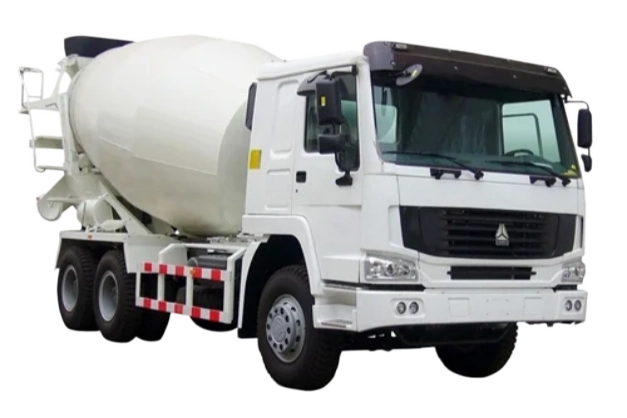
Transit Mixer Trucks
The Lifeline of Ready-Mix: You cannot sell commercial concrete without a way to transport it. Transit mixers keep the concrete agitated during delivery to prevent premature setting.
Recommendation: The size and number of trucks you need depend directly on your plant’s hourly capacity and the average distance to construction sites.
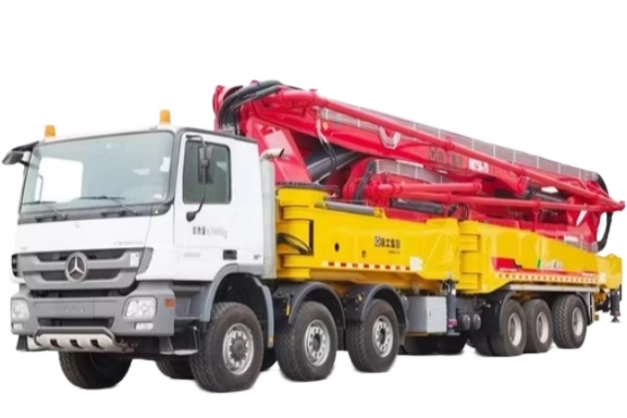
Truck-Mounted Concrete Boom Pumps
Premium Service Offering: Many clients ordering concrete for high-rise buildings or large infrastructure projects lack the means to place it. By offering a boom pump service alongside your concrete sales, you become a highly attractive “one-stop-shop.”
Recommendation: Ideal for projects requiring rapid, flexible, and high-altitude concrete placement.
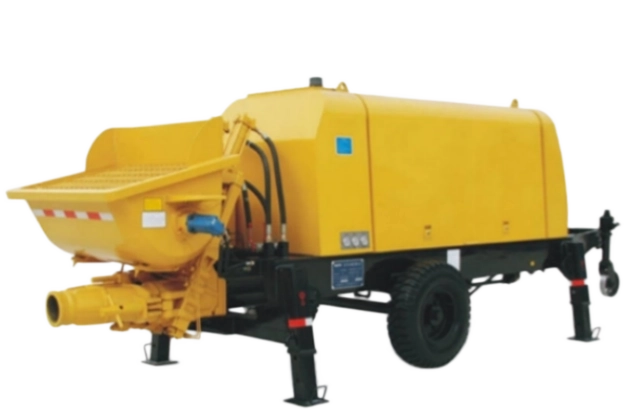
Concrete Trailer Pumps
Cost-Effective Long-Term Solution: Unlike boom pumps, trailer pumps are stationary units placed near the building site. Transit mixers discharge directly into the pump’s hopper, which then pushes the concrete through pipelines to extreme heights or long distances.
Recommendation: A highly economical choice for long-term, fixed-location projects like high-rise residential towers.
💡Pro Tip for Maximizing Profits
In the commercial ready-mix industry, suppliers who provide both the concrete and the placement equipment (trucks and pumps) command higher market shares. You can easily bundle these services and factor the equipment costs into your final price per cubic meter, ensuring a rapid return on your investment.
Best Practices for Operating and Maintaining a Ready Mix Concrete Plant
Securing a high-quality ready mix concrete plant is only the first step. Proper site installation, disciplined daily operation, and rigorous preventive maintenance are the true keys to ensuring consistent concrete quality, minimizing downtime, and maximizing the lifespan of your equipment.
Following these professional guidelines will help you achieve peak operational efficiency:
Phase 1: Site Preparation and Safe Installation
A highly productive facility relies on flawless initial civil engineering and logistical planning.
- Foundation Strength: Ensure the ground has been surveyed and compacted to provide sufficient load-bearing capacity, particularly for the towering cement silos and the heavy-duty mixing chassis.
- Logistics Flow: Allocate ample space for raw material stockpiles and design a one-way, circular traffic path for transit mixers. This prevents congestion and ensures a rapid, uninterrupted loading process.
- Utility Infrastructure: Establish industrial-grade power connections, a high-volume water supply, and proper wastewater drainage systems before mechanical erection begins to avoid operational delays.
Phase 2: Daily Operational Excellence
Consistent output requires skilled personnel and strict adherence to automated protocols.
- System Utilization: Thoroughly train your operators on the automated PLC software. They must understand how to manage diverse mix recipes, utilize dynamic moisture compensation, and switch to manual override only during emergencies.
- Calibration & Accuracy: Regularly calibrate the high-precision load cells on the aggregate, cement, and water scales to maintain strict dosing accuracy and prevent expensive material waste.
- Dispatch Synchronization: Maintain clear communication between the control room and the truck fleet to optimize delivery schedules, ensuring fresh concrete reaches the site exactly when needed.
Phase 3: Preventive Maintenance and Troubleshooting
In the commercial concrete business, unexpected breakdowns can destroy your profit margins.
- Daily Washout Routines: Implement a strict end-of-shift cleaning protocol for the central mixer interior and discharge gates to prevent concrete buildup from damaging the mixing arms.
- Lubrication Management: Routinely inspect the centralized lubrication pump. Ensuring a constant flow of grease to the mixer’s shaft-end seals is critical to preventing abrasive cement slurry from destroying the main bearings.
- Predictive Replacement: Track the operating hours of high-friction components such as mixing blades, internal liners, and conveyor belts. Replace these wear parts during scheduled maintenance windows rather than waiting for a catastrophic failure mid-production.
🤝Don’t Worry, we are Here to Help
Navigating the setup and maintenance of a ready mix concrete plant can seem daunting, but you are never alone. We provide comprehensive foundation drawings, dispatches expert engineers for on-site installation, and offers lifetime technical support. We train your local operators until they are fully confident in running and maintaining the plant.
How to Choose a Reliable Ready Mix Concrete Plant Manufacturer?
Investing in a ready mix plant is a major financial decision. Partnering with the right manufacturer ensures you receive reliable equipment, robust technical support, and long-term value. When evaluating potential suppliers, use these five key criteria to identify an industry leader:
(1) Proven Industry Experience
What to Look For: Look for manufacturers with decades of specialized experience. A long track record proves their expertise in design, production, and solving real-world engineering challenges.
Our Advantage: With over 32 years of dedicated manufacturing excellence, we have deep roots in concrete machinery, ensuring every plant we build is battle-tested and refined.
(2) Global Presence & Successful Case Studies
What to Look For: A reputable supplier should have a strong global footprint with successful installations across diverse climates and regulatory environments. Ask for project references.
Our Advantage: Our ready mix concrete plants are powering critical infrastructure projects in demanding markets worldwide, from Australia and South Korea to Southeast Asia, the Middle East, and Africa.
(3) Customization & Product Range
What to Look For: Avoid “one-size-fits-all” approaches. A professional manufacturer offers flexibility, from compact mobile units to massive ready mix plants, tailoring configurations to your exact site layout and mix requirements.
Our Advantage: We provide a comprehensive portfolio (Stationary, Mobile, Dry Mix) and specialize in Ultimate Modular Design, ensuring your plant perfectly aligns with your operational goals.
(4) Comprehensive After-Sales Support
What to Look For: A plant is only as good as the service behind it. Ensure the manufacturer provides turnkey installation, operator training, rapid spare parts delivery, and robust warranty terms.
Our Advantage: We are a full-service organization. From ROI forecasting to 24/7 remote diagnostic assistance and dispatching engineers for on-site erection, our support never sleeps.
(5) Factory Transparency & Certified Quality Standards
What to Look For: Credible manufacturers adhere to strict international manufacturing standards and welcome factory inspections. Verified certifications are non-negotiable proof of quality, safety, and environmental compliance.
Our Advantage: Our commitment to excellence is backed by globally recognized certifications, including CE, ISO, SGS, and BV. We utilize heavy-duty structural steel and premium global components in every plant we build. We invite you to visit our manufacturing facilities or request a live virtual tour to witness our rigorous quality control processes firsthand.
Buying New vs. Used Ready Mix Concrete Plant
When analyzing the total RMC plant cost, many investors are tempted by the low sticker price of second-hand machinery. However, while a used ready mix concrete plant for sale may seem like a bargain, it is often a high-risk liability.
Why New Systems Outperform Used Machinery?
- Engineering Reliability & Warranty: A used plant comes “as-is” with zero protection. An investment in a new plant is backed by a full manufacturer’s warranty, ensuring your production hub remains operational 24/7.
- Precision and Material Savings: Older batch plants suffer from mechanical wear that destroys weighing accuracy (often exceeding ±5% error). Our new automated systems guarantee ±1% dosing precision, paying for the equipment through material savings alone.
- Regulatory Compliance: Used plants often struggle to meet modern 2026 dust emission and noise regulations, risking heavy fines or site shutdowns. Our new units are built to the latest global environmental standards.
FAQ
We provide professional installation and commissioning services to ensure the correct setup and operation of your concrete mixing plant. And provide technical personnel training and support to ensure that your team receives sufficient training on operating and maintaining the concrete mixing plant.
Installation time varies based on the plant size and local site conditions. Generally, once the concrete foundation is fully cured, the mechanical erection and electrical wiring take about 7 to 15 days. This is followed by a 3 to 7-day commissioning phase to calibrate the weighing systems and test the PLC automation under load. We dispatch experienced engineers to your site to guide the entire process and ensure a swift, safe startup.
We provide an industry-leading warranty for our products, ensuring that you are not affected by any material or process defects. We are committed to quality and reliability, and your investment will be guaranteed. Learn more about our warranty coverage online or contact an representative for more details.
With robust heavy-duty steel structures, premium global components, and specialized wear-resistant mixing blades, our ready mix concrete plants are built for long-term durability. With proper daily maintenance and timely replacement of standard wear parts, our plants reliably operate for 10 to 15 years or more, even under continuous high-intensity production in harsh environments.
Concrete quality relies entirely on precise raw material proportioning and uniform mixing. Our plants achieve this through two core technologies:
First, High-Precision Weighing: We utilize independent weighing hoppers equipped with world-class S-type load cells. This isolates the scales from mixer vibrations, ensuring aggregate, cement, and water measurements are accurate to within ±1%.
Second, Advanced PLC Automation: The intelligent control system monitors moisture levels in the sand and automatically adjusts the water-cement ratio in real time. Combined with our heavy-duty Twin-Shaft or Planetary mixers, the plant guarantees a perfectly homogeneous and high-strength mix every single batch, completely eliminating human error.
Yes, absolutely. Our plants are highly versatile. By utilizing high-performance Twin-Shaft or Planetary mixers, our plants can produce normal-strength commercial concrete, high-strength concrete (C50+), zero-slump dry concrete, and RCC (Roller Compacted Concrete). Furthermore, the PLC control system allows you to store and instantly switch between hundreds of different mix recipes to meet specific project demands.
We understand that downtime equals lost revenue. We provide 24/7 remote technical support to quickly diagnose PLC or software issues. For mechanical maintenance, we supply a comprehensive package of critical wear parts with your initial shipment. Should you need additional parts, our global logistics network ensures fast delivery of genuine components directly to your site.
If your site has a stable and sufficient municipal power supply, a generator is not mandatory. However, if you are operating in a remote area with unreliable grid power or frequent outages, we strongly recommend investing in a backup diesel generator. This ensures uninterrupted production and prevents fresh concrete from setting inside the mixer during an unexpected power cut. We can advise you on the exact KVA rating required for your specific plant model.
Yes, absolutely. Our ready mix concrete plants feature an Ultimate Modular Design, which provides exceptional flexibility for future business growth.
If your production demands increase, you do not need to buy an entirely new plant. You can easily expand your operation by adding extra cement silos to increase storage, installing additional aggregate bin compartments for more complex mix designs, or upgrading to a higher-capacity twin-shaft mixer. Our control software is also fully scalable, allowing seamless integration of new components (like ice or microsilica dosing systems) without disrupting your existing workflow.
Related Products
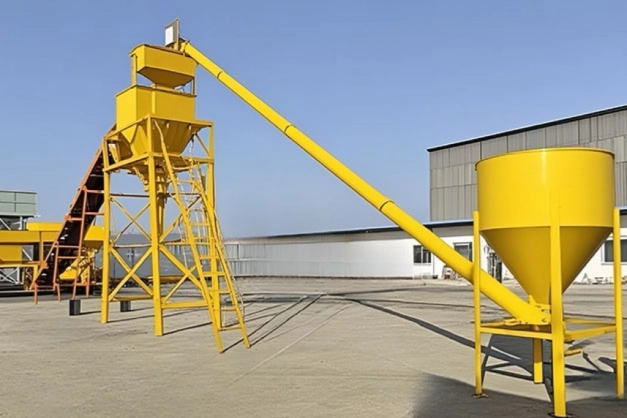
Get Your Custom Business Proposal Today
The listed price is only the beginning. The true value of a ready mix concrete plant lies in the total lifecycle performance and the strategic partnership you choose. Fill out the form to receive a transparent, itemized quotation, a professional RMC business plan outline from our senior engineering team.
FEW TIPS:
· Please describe the capacity per hour of the batching plant (e.g., 25m³/h-240m³/h).
· Please describe the type of project (e.g., building house, factory, road, bridge, dam, airport, etc.).
· Please tell us the project location and estimated project start-up date.
· Please detail your specific requirements or expectations (e.g., project site, voltage, climate, etc.).
Tell us your need, our experts will reply you with in 12 hours.